

1. What is RGB?
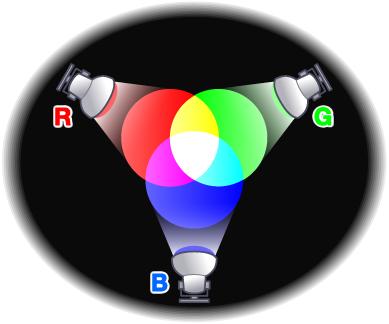
RGB stands for the three primary colors: Red, Green, and Blue. It’s an additive color model that works by combining these three light colors at varying intensity levels to create many new colors.
When all three colors are emitted at maximum intensity, the result is white light. Conversely, when all three colors are off, the system displays black. Thanks to this principle, RGB is the foundation of most electronic displays, decorative LED systems, and smart lighting solutions.
2. Understanding Color Technology in Lighting Systems
RGB is a color mixing technology widely used in electronic displays, LED lights, architectural lighting systems, and smart lighting control. Thanks to its ability to create millions of different colors, RGB makes spaces vibrant, flexible, and suitable for many purposes.
In modern lighting, RGB not only provides aesthetic effects but also enhances the experience in restaurants, hotels, showrooms, bars, and many commercial buildings. When combined with a smart control system, RGB allows for changing the color and intensity of light with just a few simple operations.
3. How RGB Works
Each RGB LED consists of three separate LED chips: red, green, and blue. The controller changes the brightness of each chip to create the desired color. This adjustment is continuous and highly precise, creating millions of different colors.
For example:
- Red is created when only the red LED is illuminated.
- Yellow is created when both the red and green LEDs are active.
- Purple is created when the red LED is combined with the blue LED.
- White appears when all three colors reach their maximum intensity.
Thanks to its flexible adjustment capabilities, RGB meets a wide range of lighting design requirements, from basic to professional.
4. What’s the difference between RGB and RGBW?
Many people often confuse RGB and RGBW.
RGB only consists of three basic colors, so creating white light requires combining all three LED chips.
Meanwhile, RGBW adds a separate white LED chip. This results in brighter, more accurate white light and is more energy-efficient for frequent use.
RGBW is suitable for spaces that need both white light for daily activities and color-changing effects.
5. Advantages of the RGB System
5.1. Diverse Color Effects
RGB can create millions of different colors, meeting a wide range of design ideas from subtle to striking.
5.2. Flexible Control
When combined with a smart control system, users can change colors, brightness, and effects via a control panel, phone, or tablet.
5.3. Energy Saving
RGB LEDs have high luminous efficiency and consume significantly less power than traditional lighting technologies.
5.4. Long Lifespan
RGB LED systems have a lifespan of up to tens of thousands of hours, reducing maintenance and replacement costs.
6. Zegal Offers Professional RGB Control Solutions
As a leading brand in the field of smart lighting control, LTECH provides a range of solutions for RGB, RGBW, and RGB+CCT LED systems.
LTECH controllers support many modern protocols such as Bluetooth Mesh, DMX, and DALI, ensuring smooth, stable, and precise color control.
Flickerless dimming and fast response times create more natural lighting effects, especially suitable for high-quality projects.
With over 14 years of experience, Zegal provides smart lighting solutions, LTECH control systems, and Barrisol translucent ceilings imported directly from France.
Zegal’s engineering team advises on solutions tailored to each project, from homes and villas to restaurants, hotels, and showrooms. The systems are designed to ensure lighting efficiency, aesthetics, and stable operation over the long term.
7. Conclusion
RGB is a crucial color technology in modern lighting. With its ability to create millions of colors and its high flexibility, RGB is widely used in many architectural and interior design projects.
When combined with intelligent control solutions from LTECH and the Barrisol translucent ceiling system implemented by Zegal, the RGB system not only delivers impressive visual effects but also optimizes user experience and enhances the value of the project.
Contact Zegal today for advice on the right lighting solution for your project.
——
For further consultation, please contact Zegal Vietnam at the information below:
Zegal Hanoi
112 Vo Chi Cong Street, Nghia Do Ward, Hanoi
Zegal Ho Chi Minh City
319 – C9 Ly Thuong Kiet Street, Phu Tho Ward, Ho Chi Minh City
Hotline: 0969 14 6688